The same food is not the same answer for everyone.
Every other scanner gives one product one score, as if everyone eating it were the same person. Verella reads the label through your goals, your conditions and your allergens, and tells you what it found and where the rule came from.
Free, all of it. No subscription, no trial, nothing held back. iPhone, iOS 16.4 or later.
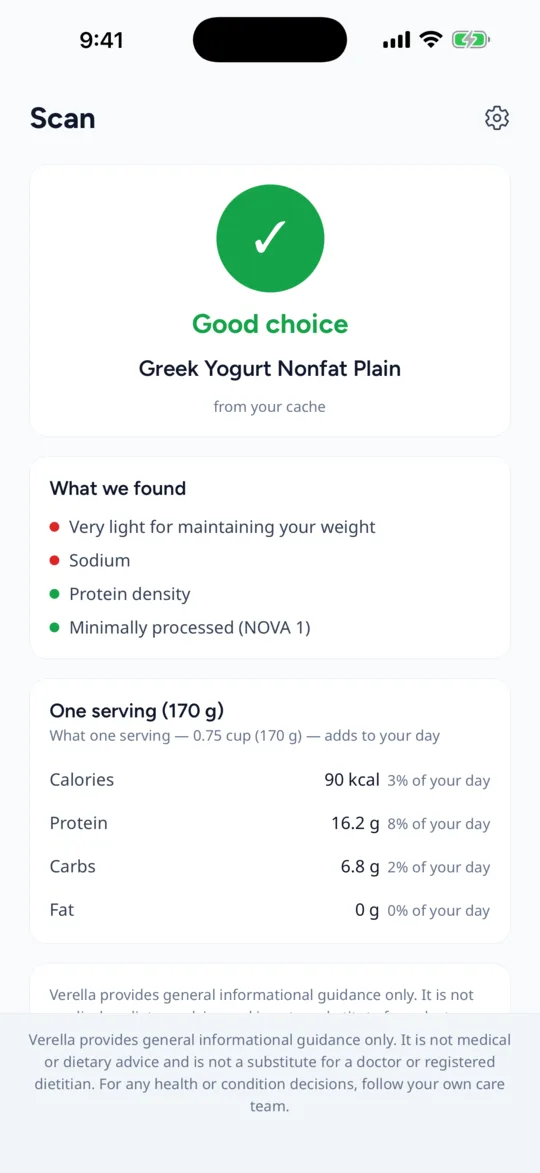
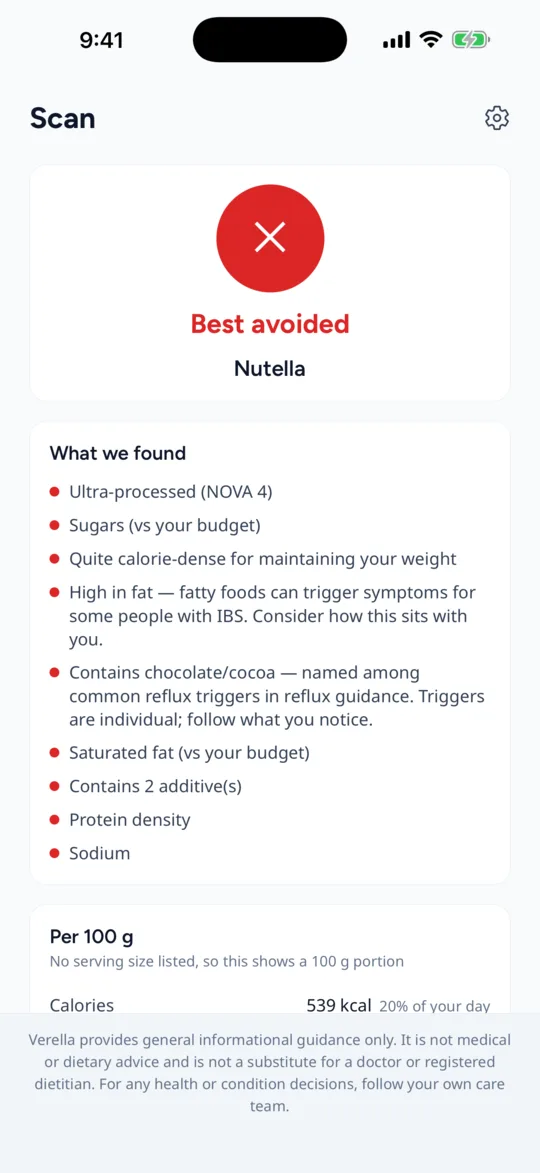
One box of cereal, two people, two answers
A toasted oat cereal with 7.1 g of fibre per 100 g. Nothing about the box changes between these two scans. The only difference is what the profile says.
Scanned by someone with high cholesterol
Better occasionallyThe fibre counts in its favour, because cholesterol guidance asks for more of it.
Scanned by someone with Crohn's disease
Best avoidedThe same fibre figure counts against it, because guidance for a flare asks for less of it.
Both verdicts above are real output from the shipped Verella engine, run on live Open Food Facts data on 5 October 2026, with only the condition changed between the two profiles. Open Food Facts data changes over time, so a scan today can differ.
A single score cannot hold both of those at once. That is the whole reason Verella exists.
What it reads on a label
| Your allergens | All 14 major allergens, matched through compound names too, so "peanut butter" is caught as a peanut. An allergen is a hard stop, never a deduction. |
| Your conditions | Six conditions, 16 published rules between them. See every rule and its source. |
| Your diet | Twelve patterns, from Mediterranean and low FODMAP to halal, kosher and keto. |
| The ingredients | Ten flagged ingredients, each one tied to a regulator that acted on it. See the watchlist. |
| The numbers | Added sugar, sodium, saturated fat, fibre and protein, measured against targets derived from your own body and goal rather than a generic adult. |
| How processed it is | The NOVA group. An ultra-processed food can still be fine, but it never reaches the top verdict. |
Four verdicts, no mystery number
Verella does not show you a score out of 100. A number invites you to compare two products that were never scored for the same reason. It gives you one of four verdicts, and then it shows its working.
- Good choice
Nothing in the label works against you, and several things work for you.
- Fine in moderation
A reasonable thing to buy. Nothing here needs avoiding, nothing here is remarkable.
- Better occasionally
Something on this label counts against you often enough that it is worth noticing.
- Best avoided
Either an ingredient a regulator has acted on, or an allergen you told Verella about, or enough counting against it that nothing else outweighs it.
Read the rules before you install anything
Verella is a health app, so the fair question is where its rules come from. They are all here, written out: the threshold that triggers each one, the exact wording the app shows you, and the published guidance behind it.
How Verella pays for itself
With ads, and that is the whole business model. There is no subscription and nothing to buy inside the app. Every scoring feature, including your conditions, your diet patterns and your allergens, runs for everyone.
Ads are never personalised. Nothing about your health, your allergens or the products you scan is used to choose one, and the app never asks for tracking permission or touches the advertising identifier.
Ads also never appear on a scan result, and an interstitial is suppressed entirely when you are leaving a result that carried an allergen warning.
Not on iPhone?
Verella is iPhone only right now. Leave your email and we will tell you when that changes.
One email when it happens. Nothing else.